Whooper Swans and Mining Bees in Tokavaig Woods

22nd April 2014

On Loch Meodal on Skye's southerly Sleat Peninsula, Mallard junior (Anas platyrhynchos) gets lost amongst the reeds.


Spotting mam and sibling rivals already far away in the distance he presses the turbo engage button and webs it in hot pursuit, fueled by fear of the big world and anger at his family's callous attitude.


They're going to get a big telling off!


Late in the year for Whooper Swans (Cygnus cygnus) on Loch Meodal, resting on their journey back to Iceland. There seem to be two adults and four juveniles. The adults appear to have a slight brownish hue to the neck which is characteristic of spring-summer plumage.


This adult bird has a noticeably more orange, rather than yellow bill colour.


It also has a yellow leg ring, indicating, as one would expect, that it was ringed in the UK.


Arriving at the western shore of the Sleat Peninsula, looking across to Strathaird. I think the stretch of water is Loch Slappin, coming down from the north, though in reality it's sort of merged with Loch Eishort which descends from the north east.


 We had expected to see quite a few birds in Tokavaig Woods but although we could hear them, they proved to be visually very elusive and this Willow Warbler (Phylloscopus trochilus; photo by David) was about all we spotted.


Then David saw something a little different, in fact a whole nest of them.

 (Photo by David)

The following exchange then occurred:
26 Apr  Steve - I sent your photo to Murdo at HBRG and this was the response:
Murdo - A male Andrena [Mining Bee] . There are several possibilities, so if you could grab one and send it to me it would be useful. A. ruficrus, clarkella and fucata would all be in the frame, and it would be good to get down to species, especially from Skye where we know little about the solitaries.
27/4   Steve - From David's excellent photo Murdo (HBRG) was able to say that it was a mining bee member of the Andrena genus. You can read more about them here: http://www.hbrg.org.uk/FoHW/SolBees/SolBees.html . He needs a specimen to put under the microscope before he can tell us what species it is. So this morning I returned to Tokavaig Wood, managed to re-find the location, and, to my relief, they were still there! A specimen is now sitting in my fridge! Having achieved my primary objective, I spent an hour collecting more botanical records and on the way back down the road spotted a Green Hairstreak! (see website for photo)
29/4   Steve - I'm sure you've all been dying to know - our bee turned out to be Andrena clarkella! Ours appears to be a first record for Skye! http://www.bwars.com/index.php?q=bee/andrenidae/andrena-clarkella
29/4    David - Brilliant, how cool is that. Christine has the first ever Red Rumped swallow and I get an Andrena Clarkella!
29/4    Yes, they should rename it Andrena hammondii tokavaigus!


Adrena clarkella (photo by David)

I am assuming that, having spent a night in Steve's fridge and a day under a microscope, all for the benefit of science, Clarky here was given tea and biscuits and chauffeur driven back to his nest with a fine souvenir photo album of his exploits to show to his grandchildren.

Camas Ban on Loch Portree, Birds of Prey

23rd March 2014

 Looking northwards over Loch Portree to the Old Man of Storr.


 Camas Man beach; sheep looking for a deck chair and a toffee apple.


 Fooled once again; what appeared to be two circling Golden Eagles proved on closer inspection to be Common Buzzards (Buteo buteo), with the typical buzzard colour pattern on the underside of the wings.


 Nature's own Cheerios


 An unusual lichen, though Linda insisted it was polystyrene.


 We thought it was a Merlin at first but subsequent analysis of images revealed a Common Kestrel (Falco tinnunculus) (image by Bruce).


 White-tailed Eagle (Haliaeetus albicilla) (image by Bruce). 


 (Image by Bruce)


 Notice the coloured ring on the left leg and the metal ring on the right leg.


 The ring is silver over red, indicating that the bird was ringed in 2008.


February on Skye - Bruce espies otter and American Black Duck

February 2014

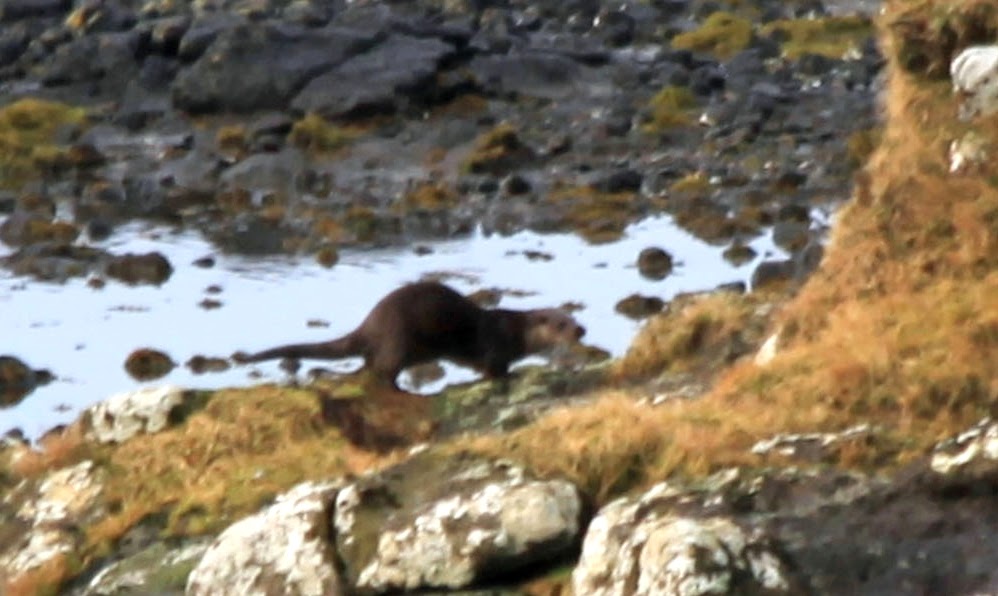
 A Eurasian Otter (Lutra lutra) on the shore of Loch Dunvegan photographed by Bruce.


1st

 Winter returns, coating the south Trotternish Hills with castor sugar.


4th

 A Raven (Corvus corax) and Ben Tianavaig. Skeabost is Raven City.


 What do you do when a gang of bovine ne'er-do-wells blocks your only way home?


 Stroll on with a jaunty, nonchalant air, in the secure knowledge that these beasts will recognize one born in the year of the ox and greet him as one of their own.


 See here Jimme, it's horn-up-the-sporran time fer youz!


Finally I remembered my Vegan Society membership card. A quick flash of that while holding my thumb strategically over the expiry date, "It's okay guys, I'm on your side", and we were all good pals.


7th

The soil and the water in it are heated by solar infrared radiation which increases the vapour pressure of the water, allowing more of the H2O molecules to escape into the atmosphere as a gas. As the air is thinner than the soil and therefore doesn't absorb as much solar radiation, it is cooler. The gaseous H2O molecules therefore lose vibrational energy by collisional transfer to other air molecules and begin to coalesce (hydrogen bond with each other) around tiny particles of dust, forming water droplets (mist). Well, maybe that's what happens.


12th


Some time in February

A very rare American Black Duck (Anas rubripes) spotted by Bruce at Strontian, near Loch Sunart on the west Scottish mainland. This duck has apparently been hanging around in Scotland for about a year. Bruce says he went away for 30 minutes and when he got back some twitchers who had been feeding the ducks with bread had disappeared, along the Anas rubripes. Bruce: "...maybe they kept it in their car boot and drove around releasing to cause sensational reports. It was mentioned in the Press&Journal".


Mallards (Anas platyrhynchos) at Strontian, imaged by Bruce. Notice the vivid blue bill of the female. I wonder where she got that. Probably some form of hybridization, unless Bruce had been at work with the old paint pot, a well known ploy of wild life photographers.


16th


A flock of Fieldfare (Turdus pilaris) at Skeabost. This was part of a flock of around 130 who seem to be spending the winter here. One problem with this blog site is that if a photo is on the dark or light side it is automatically corrected, even though one intends it to be dark or light. So the above image should be brighter and without colour artifacts. Left click on the image to see a larger version.


A local community of Starlings (Sturnus vulgaris).


Cumulus congestus cloud massing over the Cuillin. These clouds are usually formed as warm (solar heated) moist air rises, creating a convection current (thermal) which brings up more air. Of course, in this instance, the upward movement of the air was in part due to being forced upward as the wind hit the Cuillin. As the column of rising air pushes higher, the pressure of the air around it becomes lower and thus the air in the column expands outwards and in so doing expends kinetic (vibrational) energy and starts to cool. Condensation occurs when the potential energy of  hydrogen bonding (the positively charged hydrogen atoms in one H2O molecule bonding to the negatively charged oxygen atom in another H2O molecule) exceeds the kinetic energy, and water droplets are formed. As the water molecules become bonded to each other the vibration of the molecules is further restrained and the molecular kinetic energy is converted into heat (heat of condensation). This heat reduces the rate of condensation and causes the droplet-filled air to rise still further and the cloud therefore builds and builds until it reaches a point (inversion) where the temperature of the surrounding air is actually increasing with height, and when the temperature of the rising column is equal to that of the surrounding air it ceases to rise and begins to spread horizontally, sometimes forming an anvil shape. Well, maybe something like that happens.


A few Fieldfare join with the Starlings as they strut their stuff.


Crossbills (Loxia curvirostra or Loxia scotia), depending on whether they are Common or Scottish.