July 2012


3rd

The Quest for Adventure lies moored in Portree Bay against the background of the gruelling ascent up Ben Tianavaig which we made earlier in the year.


A nice multicoloured display with a southern marsh orchid at the centre. Steve's IDs: tormentil (Potentilla, upper right), birdsfoot trefoil (Lotus corniculatus, centre left), and speedwell (Veronica, lower left).


Sea plantain (Plantago maritima)


Northern side of Portree Bay


                                                                             Heath spotted orchid (Dactylorhiza maculata)


Identified by Steve as valerian; probably common valerian (Valeriana officinalis).


13th, south of Coral Beaches

An umbellifer, yet to be identified. Maybe a young giant hogweed! Steve's ID: hogweed (Heracleum sphondylium).


Cool beans; identified by Steve as bitter vetch (also known as bitter vetchling, Lathyrus linifolius, formerly known as Lathyrus montanus).


A common sandpiper (Actitis hypoleucos)


Eyebright (Euphrasia officinalis)


Re-identified by Steve as slender St. John's wort (Hypericum pulchrum).


A juvenile northern wheatear (Oenanthe oenanthe)


16th, Camas a Mhor-bheoil

A juvenile pied wagtail (Motacilla alba)


Looking north along the Sound of Raasay.


Ben Tianavaig


17th, Kilmuir

Another umbellifer, this time with a pink tinge; identified by Steve as possibly angelica.


Looking north west to Fladda-chuain, showing it's a popular spot for birds, with Harris in the background.


Sea campion (Silene maritima)


Identified by Steve as Scots lovage (Ligusticum scoticum).


Idntified by Steve as lousewort, though I'm not sure whether it is lousewort (Pedicularis sylvatica) or marsh lousewort (Pedicularis palustris) as the flowers look very similar.


Sea mayweed (Matricaria maritima)


The cliffs at Kilmuir


Fulmar with chick (Fulmarus glacialis)


Fulmar chick


Family life


And finally, fulmars.


19th
A blue pig in the sky, his hair blowing in the wind.

Cirrus uncinus - "Mare's tails and mackerel scales make tall ships carry low sails".  Ice crystal gently descending from a height of around 6 km where they formed from the sublimation of scanty water vapour in rising relatively dry air. When mare's tails are pulled by wind towards the horizontal, this means impending turbulent weather.


20th
Rook (Corvus frugilegus)

Loads of new house sparrows (Passer domesticus) on the feeders this year.


28th

Rock dove (Columba livia) with non-standard plumage.

Isle of Oronsay

On 9 July 2012 six of us set out for the small Island of Oronsay in Loch Bracadale, Isle of Skye, having checked the tide times so that we could walk across the causeway. A fairly lively wind made observing somewhat more difficult, especially for those of us who needed a hair cut.


Approaching

The Island of Oronsay


The causeway


Marsco looming in the distant south east


Six-spot burnet (Zygaena filipendulae) on birdsfoot trefoil (Lotus corniculatus).


A couple of fulmars


A smashing bit of cliff, the distant dot being Linda.


A common gull chick wearing a bathing cap, or possibly a reincarnation of Ena Sharples.

A sea cave on the south side of Oronsay. If you zoom in you'll see some rock doves in their natural environment.
Ringed plover (Charadrius hiaticula)
Looks like southern marsh orchid (Dactylorhiza majalis) - re-identified by Steve as heath spotted orchid (Dactylorhiza maculata).
Everyone's going home for tea.

Greshornish Point

On 11th June four U3A travellers met on the Greshornish Peninsula and proceeded north, very soon encountering the first natural phenemenon near the Greshornish Hotel.

Tree lungwort (Lobaria pulmonaria), a lichen (i.e., a fungus containing algal cells).


As we proceeded into a more boggy area, made relatively dry by the unusual lack of rain on Skye, the following appeared:

Identified by Bruce as milkwort - later identified more specifically by Steve as almost certainly heath milkwort (Polygala serpyllifolia).


Triffids? Now identified by Steve as round-leaved sundew (Drosera rotundifolia), presumably an insectivore.


Common butterwort (Pinguicula vulgaris), an insectivore.


The following were living in the vicinity of the shoreline.

Silverweed (Potentilla anserina)


A Chenopodium species

Another Chenopodium


And back towards the bog.

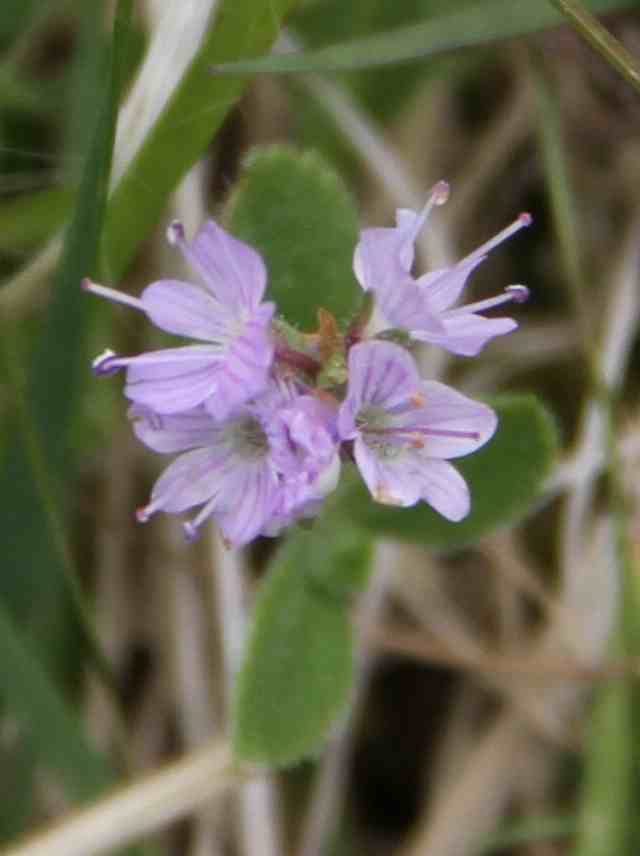
Identified by Steve as heath speedwell (Veronica officinalis).

A common shrew (Sorex araneus) having a nap.


Awaiting ID.


More Veronica.


A common eider (Somateria mollissima) with her chicks on Loch Greshornish. There were 3 eiders with a total of 11 chicks.


A meadow pipit (Anthus pratensis).


Bog asphodel (Narthecium ossifragum)
Wikipaedia - "The Latin name means "weak bone", and refers to a traditional belief that eating the plant caused sheep to develop brittle bones. The probable origin of this story is that sheep eating a calcium-poor diet are likely to develop bone weakness, and N. ossifragum favours acidic, low calcium soils."
"The plant causes a disease in sheep called alveld, "elf fire", in Norway", though not all plants are toxic; the toxicity could be caused by a fungus.


A black guillemot (Cepphus grylle) on Loch Greshornish.


Looking across Loch Snizort to Ru Idrigill, with a ferry from the Outer Hebrides entering Uig harbour and the settlement of Totescore in the background. Note the long volcanic dyke running down the hill.


Heath spotted orchid (Dactylorhiza maculata)


English stonecrop (Sedum anglicum)


Bufo metallicum


Razorbill (Alca torda)


Sea arrowgrass (Triglochin maritimum)


Thrift among the boulders.

 
Identified by Steve as roseroot (Sedum rosea).

Volcanic dyke on Greshornish Point.


Volcanic dyke (localized vertical dolerite intrusion); one can see the ends of horizontal cooling joints?


Sea anemones - Crimson anemone (Cribrinopsis fernaldi)?


Oyster catcher (Haematopus ostralegus)


Looking east over Greshornish Point.


Looking down the western side of the Greshornish Peninsula. The eastern edge is near to sea level.


A solitary, singing twite (Carduelis flavirostris).


A tiny glimpse of a red rump, indicating a male twite.


Sea campion (Silene maritima)


David and Tony about to tackle a rather dodgy path on the cliff side.


A grinning sea stack.


Willow warbler ((Phylloscopus trochilus)


Identified by Steve as small heath butterfly (Coenonympha pamphilus).


Greshornish is well worth a visit, with the widest variety of flora and fauna that I've so far encountered on Skye. The sort of place where one could enjoyably spend an entire day.